Early Drought Caution
Combined storage — 27 April 2026
47%

The lowest Cape Town has been at this point in the calendar since Danger Year 2018.

vs last year
−21%
Lowest April since
Apr 2019
Cape Town dam basin cross-section A bowl-shaped cross-section of combined dam storage. Current level is 47.3%. The healthy reference line sits at 70% and the Day Zero threshold at 20%. HEALTHY AVG — 70% WHERE LEVELS SHOULD BE NOW — 47.3% EARLY DROUGHT CAUTION DAY ZERO — 20% TAPS RUN DRY AT THIS LEVEL FULL 100% ↑ ↓ EMPTY 0% 100% 70% 47% 20% 0%
Scroll
capetowndamlevels.co.za 28 Apr 2026
The system in six readings

April delivered.
And May is bringing more.

What just fell, what just left the tap, and what the sky is bringing next — read in pairs, as cause and effect.

01 Supply — What came in
01 Rainfall · April · 3 stations

Twice the usual
April rain.

2.0× normal
Theewaterskloof 81mm · 1.5×
Voëlvlei 90mm · 2.2×
Wemmershoek 157mm · 2.3×

Verdict Much wetter than normal — close to twice the typical April.

02 Storage · 6 dams combined

The dams felt it —
up 2.6 points.

47% was 45% last week
2-week trend +2.6 pts
20 Apr 2026 27 Apr 2026

Verdict Rising, but still inside the caution band.

02 Demand — What went out
03 Daily demand · vs target

The city is using
less than it should.

892Mℓ 83 Mℓ under target
Used today Target 975 Mℓ

Verdict 9% below the daily target — the kind of week that buys headroom.

04 Per person · ℓ/day · 12-mo avg

8 litres less,
per Capetonian.

152ℓ/day −8 ℓ vs trailing avg
Trailing 12-month average
0 ℓ 200 ℓ

Verdict A small but real saving — sustained, this is what shaves a percentage point off summer drawdown.

03 Forecast — What's coming next
05 Forecast · 7 days · 6 catchments

4 times a typical
week of rain.

4.0× normal
Day-by-day · mm 44 mm vs typical 11 mm
typical · 2 mm/day
0
Thu
0
Fri
4
Sat
0
Sun
12
Mon
6
Tue
24
Wed

Verdict Wed looks like the wettest day.

06 Where it lands · per catchment

Each dam, and
what's coming for it.

5.1× a typical week
Each dam · % full now below 60% 60%+ safe 75% comfortable
Theewaterskloof 47% +40mm 3.0× normal
Voëlvlei 50% +32mm 8.8× normal
Berg River 46% +61mm 5.7× normal
Wemmershoek 50% +55mm 5.5× normal
Steenbras Upper 57% +57mm 3.9× normal
Steenbras Lower 37% +69mm 3.7× normal

Verdict Steenbras Lower (37% full) and Berg River (46% full) get the biggest soaking.

Looking ahead Two soaking weeks back-to-back is the kind of run that meaningfully shifts the May curve. The next reading will tell us how much of it stuck.

updated weekly · sun 09:00 SAST
Day Zero predictor — move the sliders

What if?

Pick a rainfall scenario and drag the consumption fader. Pin one configuration and overlay another to compare. The model runs a thousand simulated years against Cape Town's seasonal pattern and shows when the system would empty.

Rainfall scenario
Projected combined storageMedian · 25–75 band · 1,000 runs
100%75%50%25%0%APR 26JULOCTJAN 27APRTODAY · 47%
Daily consumption850ML/day
600 · drought-era1200 · unrestricted
about today's usage
What this means

Day Zero is possible — but not the likely outcome.

The line on the chart is the typical projection: it bottoms out at 26%, above the 13.5% Day Zero line. But the model also runs 1,000 different rainfall futures, and roughly 1 in 7 of them (14%) does cross Day Zero — usually around May 2027. The shaded band on the chart shows that range of possibilities.

Monthly storage · median path
May 26
44%
Jun
49%
Jul
57%
Aug
64%
Sep
63%
Oct
59%
Nov
56%
Dec
51%
Jan 27
46%
Feb
39%
Mar
33%
Apr
30%
May
26%
Jun
31%
Theewaterskloof — drag to compare

The same dam, two moments.

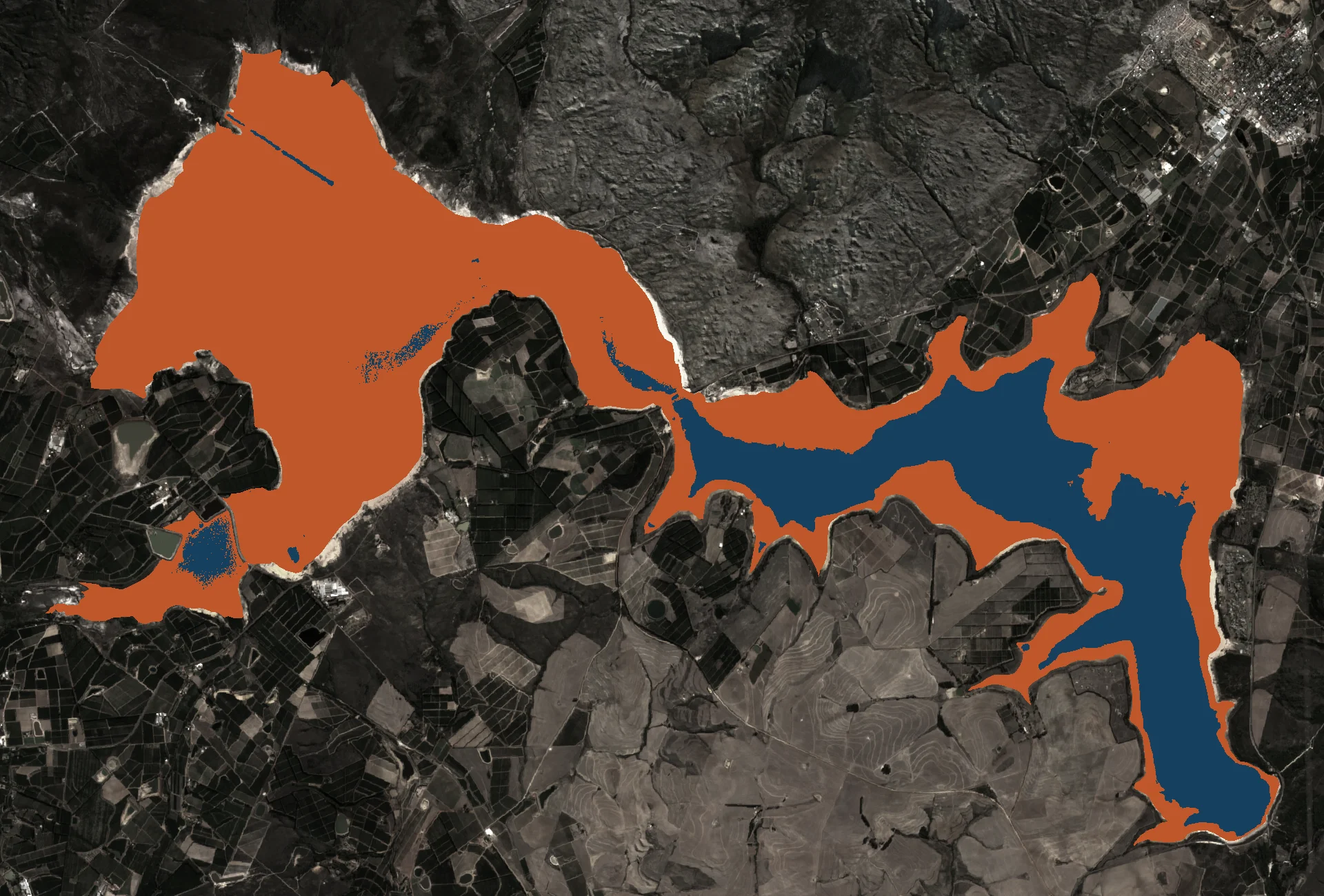
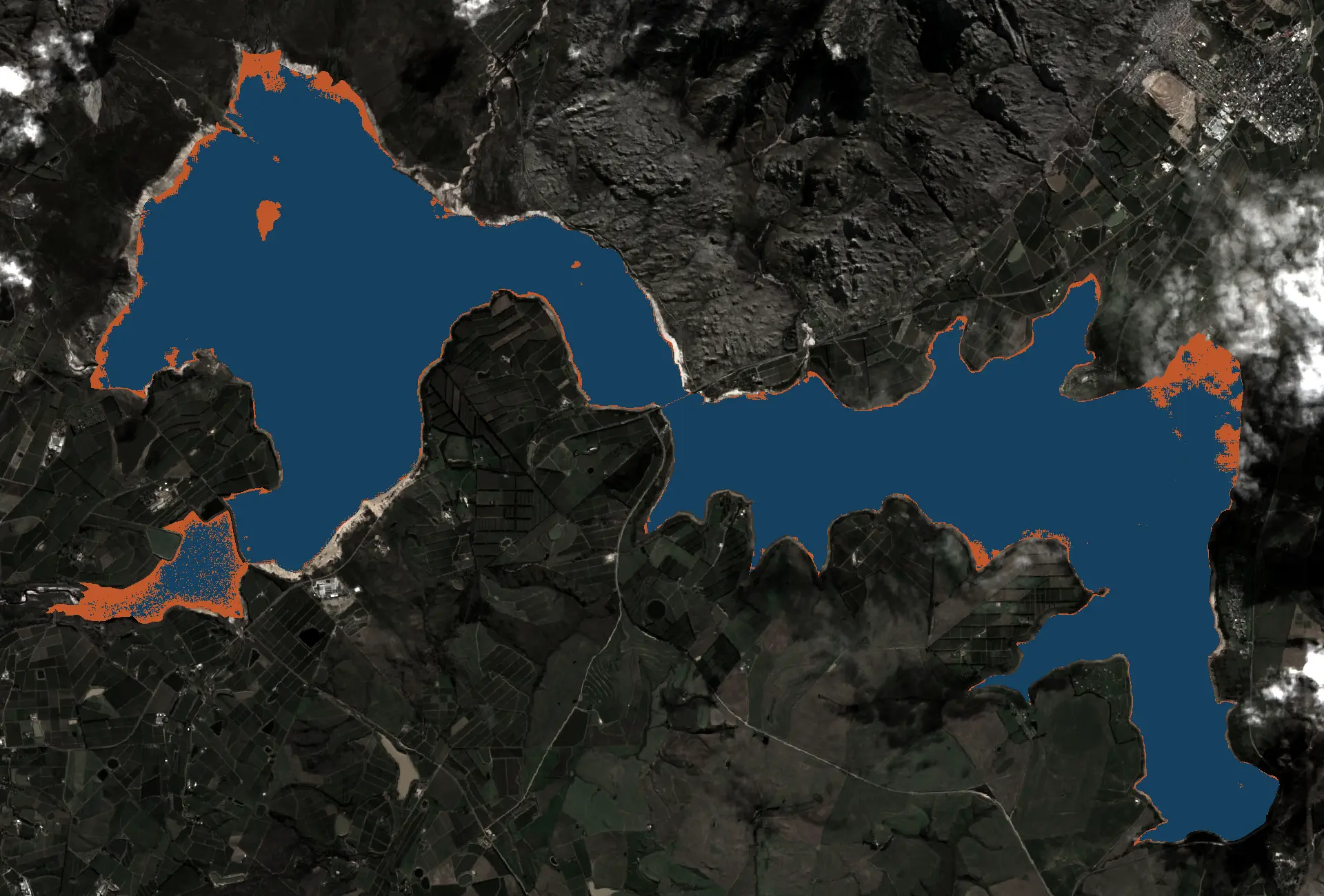
Sentinel-2 satellite imagery of Theewaterskloof, which holds more than half the system's capacity. On the left: May 2018, at the edge of Day Zero. On the right: today.

May 2018 · 21.4% full
April 2026 · 47.3% full
May 2018 · 21.4% full
April 2026 · 47.3% full
Exposed lakebed · total capacity reachCurrent water