In early 2018, the City of Cape Town came within weeks of shutting off the municipal water network and sending four million residents to queue at emergency taps. The day it would have happened was called Day Zero, and it was averted by demand reductions, not rain.

On 1 February 2018, every household in Cape Town had a fifty-litre daily limit on water — drinking, cooking, washing, the toilet, the lot. The combined dams held about a quarter of capacity. The City had set a date called Day Zero: the day the municipal taps would close and four million residents would queue at one of two hundred collection points for 25 litres a head.
That date was redrawn three times in five months. Then the rain arrived.
What stopped Day Zero was not the rain. The taps stayed on because Capetonians, the City’s pressure engineers and a small army of plumbers cut daily water use almost in half between 2015 and 2018. By the time the winter of 2018 arrived, demand had already moved further than supply.
What Day Zero meant
Day Zero was not the day the dams hit zero. It was the date the City would deliberately shut off the bulk of the municipal supply and shift Cape Town to emergency rationing.
Two thresholds did the work. Level 6B restrictions, in force from 1 February 2018, capped each person at 50 litres a day for everything combined. If the dams kept dropping, that limit would fall to 25 litres, collected in person from one of about 200 water points across the city.
Fifty litres is a quarter-bath. Twenty-five is what you can carry home in two large bottles.
The cut-off the City was working toward was 13.5 percent combined storage in the Western Cape Water Supply System. Below that line, the bottom of each dam becomes too shallow and silt-heavy to draw cleanly. The threshold sits a few points above the dead-storage floor, leaving the City an operational margin before flipping the network to a rationing model.
Three winters of bad rain
Cape Town has a Mediterranean climate. The catchments soak in May, June and July, and the dams refill on those three months, or they don’t.
Between 2015 and 2017, they didn’t. Combined storage entered May 2014 at 72 percent of capacity. By mid-May 2017 it was at 21 percent. By mid-May 2018, still 21. A World Weather Attribution study led by Friederike Otto found that climate change had made a drought of that severity around three times more likely than it would have been a century earlier.
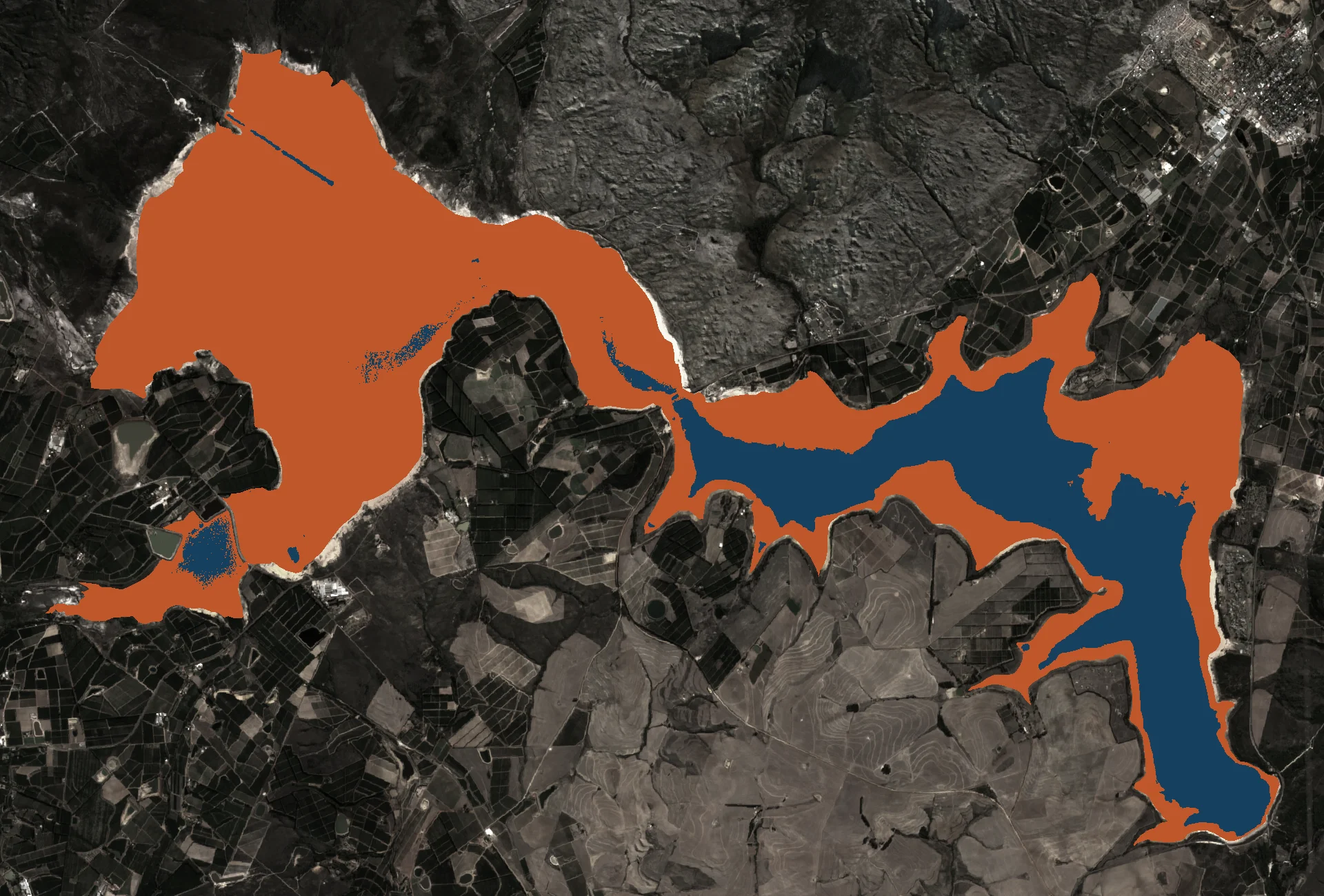
Theewaterskloof, the largest dam, holds just over half the system’s storage on its own. By early 2018 it had dropped close to 10 percent of capacity, with most of the remaining water unreachable in practice. The exposed lakebed became the visual shorthand for the crisis.
How the city pulled back
The interventions ran in parallel, and most of them were unglamorous.
The City reduced network pressure, so taps ran slower and burst pipes lost less. It fitted water-management devices on the highest-volume households. It published a public water map colour-coded by consumption band. It raised tariffs on the upper blocks so steeply that filling a swimming pool became one of the most expensive things a household could do.
Daily water use fell from about 1,200 megalitres a day in February 2015 to roughly 500 ML in February 2018, a drop of more than half. Per-capita use went from over 200 litres a day to under 100 at the peak. The International Water Association later named Cape Town the leading water-saving city of that period.
When meaningful rains arrived in mid-2018, the dams started to refill into a system that was, for the first time in decades, using far less than it had been built to deliver.
Did everyone live the same crisis?
About half the city’s population lives in the townships and Cape Flats neighbourhoods that run east and southeast from the centre: Khayelitsha, Mitchells Plain, Gugulethu, Philippi. That half consumes about 5 percent of the city’s water. Many residents collect from communal taps or share a single connection between several households.
As the activist Zama Timbela told National Geographic in 2018, people in those areas “have been living in Day Zero for many years.”
For Constantia, Bishopscourt and Camps Bay, Level 6B was a confrontation. For thousands of households on the Cape Flats, fifty litres a day was already the daily reality. Most of the demand reduction came from middle-class and wealthy suburbs because most of the demand had always come from there.
Could Day Zero return?
The 13.5 percent threshold is still the operational definition the system uses. The Day Zero predictor on this site uses it as the cut-off when running a thousand simulated years against the Cape’s seasonal rainfall pattern.
What changed after 2018 is the demand side. The City has held average consumption far below pre-drought levels even as the population has grown. New desalination, water reuse and groundwater projects in Cape Town’s New Water Programme are adding supply that does not depend on rain. By the programme’s 2031 completion date, those sources are expected to cover roughly a third of daily use.
What did not change is the climate. Winter rainfall in the Cape’s mountain catchments is more variable than it used to be. A 2020 PNAS modelling paper found the risk of another Day Zero-scale drought rises through the rest of the century.
The next time the catchments give the system three dry winters in a row, the curve will bend the way the 2017 curve bent. The difference will be what the city does in the months before the dams force the question. Watching the combined dam levels in May, when the dry season is closing and the winter rain has not yet arrived, is the simplest early signal. The Day Zero predictor lets you drag the rainfall and consumption sliders against that pattern.
Day Zero was avoided in 2018, for now. The phrase still does its work. It names the moment a major city decided it had to plan for the day the water did not come.